Ducati Panigale V2 Review: Superbike Drama, Finally Usable
The 2026 Ducati Panigale V2 keeps the supermodel looks and adds real-world usability. We find out if Ducati's 'friendly' superbike is actually friendly.
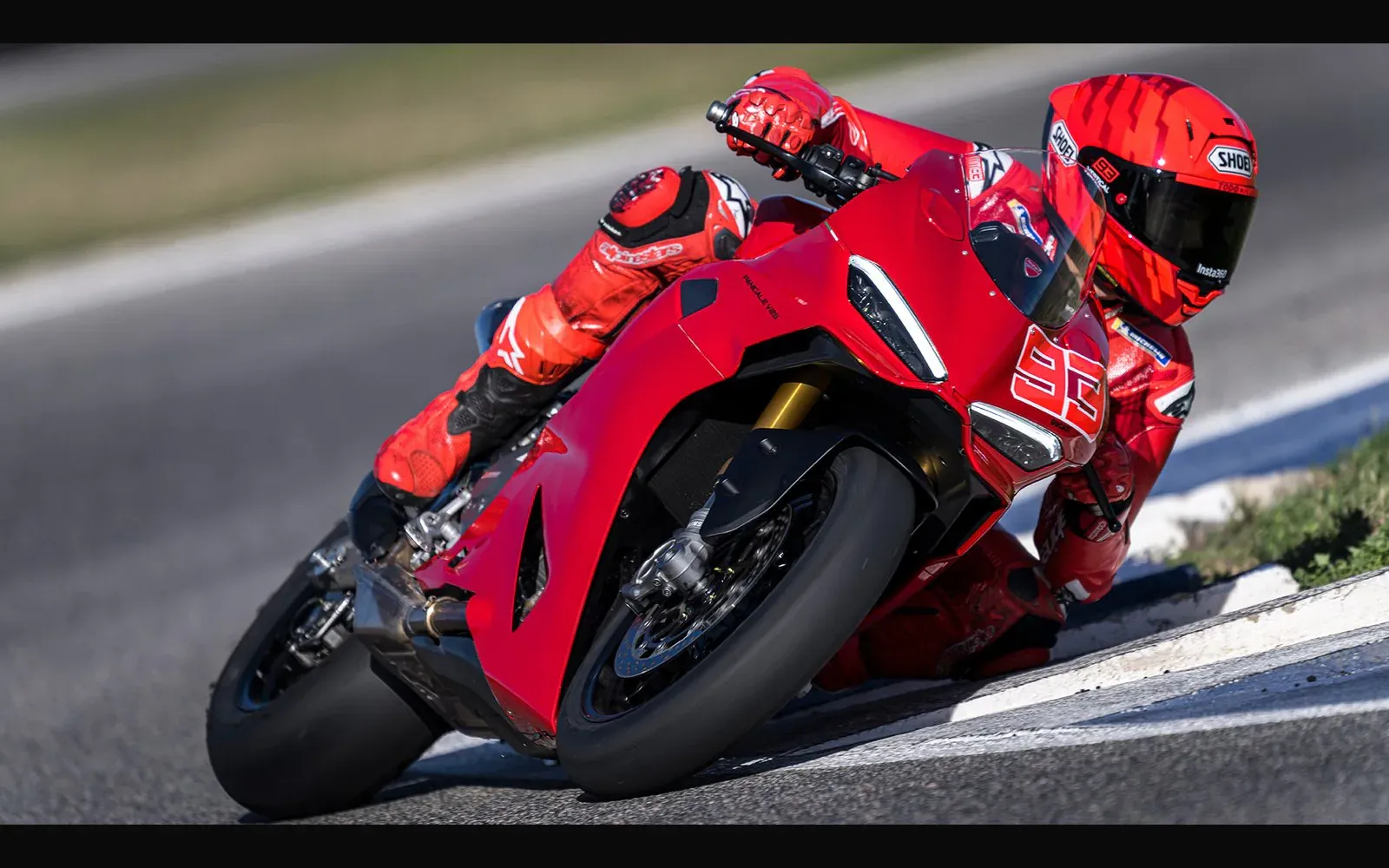
There's a particular kind of motorcycle that ruins you for everything else, and it usually does it in a parking lot before you've turned a wheel. You walk up, you crouch a little to take in the line of the tail, the way the trellis of bodywork wraps the tank, the single-sided swingarm baring a fat rear tyre like jewellery, and something in your wallet quietly surrenders. The Panigale has always done this. It has always been the supermodel of the superbike paddock: impossibly photogenic, a little aloof, and historically a touch high-maintenance once the photoshoot ended. For 2026, Ducati did something braver than another power war. It kept the face and rebuilt the personality.
Less peak power is the whole point
Let's get the number that will upset the forums out of the way. The old Panigale V2 ran a 955cc Superquadro V-twin that screamed out around 155 horsepower. This new bike, built around an all-new 890cc 90-degree V2, makes roughly 120 hp (88 kW) at 10,750 rpm. On paper that reads like a step backwards. In the real world it is the most important thing Ducati has done to this motorcycle in a decade.
Here is why. That old 955 was a top-end instrument. It wanted revs, commitment, and a racetrack to make sense of itself, and on a B-road it spent most of its life sulking below the part of the tacho where the magic lived. The new engine flips that relationship. Peak torque is about 93 Nm at 8,250 rpm, but the more telling story is everything beneath that figure: there is real, usable shove from the moment the bike is awake, a low and midrange surge that means you stop chasing the redline and start short-shifting out of corners with a grin. You ride the torque, not the tachometer.
The old V2 made you earn the fun. The new one hands it to you on the way out of every second-gear hairpin.
Crucially, the engine is a stressed member again, and it has been put on a diet along with everything bolted to it. The result is a claimed kerb weight of around 176 kg, which makes this the lightest Panigale V2 ever built, roughly 15 kilos lighter than the bike it replaces. Fifteen kilos is not a rounding error on a motorcycle. It is the difference between a bike that turns when you ask and a bike that turns when you insist. It changes how the thing stops, steers, and forgives, and you feel it everywhere.
A chassis that flatters instead of tests
Underneath the sculpture sits an aluminium monocoque frame, the clever Ducati trick of using the airbox casting as the main structure. Hang the new lighter engine off that, drop the overall mass, and you get a machine that feels almost telepathic at turn-in without the nervous, edgy steering that used to be the price of Ducati sharpness.
On a genuinely good road, this is where the V2 earns its score. It is precise in the way only a Ducati seems to manage, that sense of the front tyre being wired directly to your fingertips, but the updated geometry and a more compliant setup mean it no longer punishes you for the surface being imperfect. The base bike rides on a Marzocchi 43mm fork and a Sachs shock; the up-spec S trades those for Öhlins if you want the sharper, firmer toy. Brembo radial calipers of the M4.32 / M50 class haul it down with the linear, confidence-inspiring bite that lets you brake later than you should and live to tell it.
Is the ride soft? No. This is still a sportbike, and on a chewed-up surface it will let you know about every expansion joint. But it has crossed an important line: it now flatters an averagely talented rider rather than auditioning them. You finish a fast section feeling like a hero instead of like you got away with something.
Living with a beautiful thing
The honesty section. A Panigale is a Panigale, and physics has not signed a waiver. The riding position is committed, with clip-ons that load your wrists and rear-sets that fold your knees, and the roughly 837 mm seat height plus narrow waist means shorter riders should sit on one before signing. In stop-start traffic on a hot day, a compact V-twin pressed against your shins generates exactly the heat you would expect, and the V2 does not pretend otherwise. This is a bike that rewards moving air.
What makes it genuinely liveable now is the electronics package, which is comprehensive without feeling like a spreadsheet strapped to a fairing. A 6-axis IMU underpins cornering ABS, Ducati Traction Control, wheelie control and engine-brake control, all adjustable across multiple ride modes and displayed on a clean 5-inch TFT. The up/down quickshifter is excellent, turning the commute into a series of clutchless flicks, and the safety net of lean-sensitive electronics means the bike's friendlier midrange is backed by a system that quietly has your back when the road turns damp or your enthusiasm outpaces your judgement.
The cumulative effect is a superbike you can actually use on a Sunday and not resent on Monday. You can ride it to a café, take the long way home, and not arrive feeling like you wrestled an alligator. That used to be a contradiction in terms for this badge.
Who it's for, and the value question
This is the part that needs an honest answer, because the V2 sits in an interesting spot. Starting around $15,995, it is not cheap, and there are middleweight nakeds and even some inline-four sportbikes that will out-accelerate it for similar or less money. If your scorecard is purely horsepower-per-dollar, the V2 loses that argument and does not much care.
Because that is not what you are buying. You are buying the way it looks parked outside, the way the V-twin pulses beneath you, the way a fast road unspools beneath a chassis that feels carved rather than assembled. You are buying the most usable, most forgiving, lightest Panigale ever made without giving up an ounce of the drama that makes people fall for these bikes in the first place. For the rider who wants exotic feel and genuine everyday usability in one impossibly pretty package, that is a very compelling trade.
Key specs
| Spec | Detail |
|---|---|
| Engine | All-new 890cc 90° V2, liquid-cooled |
| Power | ~120 hp (88 kW) @ 10,750 rpm |
| Torque | ~93 Nm @ 8,250 rpm |
| Kerb weight | ~176 kg (lightest Panigale V2 yet) |
| Frame | Aluminium monocoque |
| Suspension | Marzocchi 43mm fork + Sachs shock (Öhlins on S) |
| Brakes | Brembo M4.32 / M50-class radial calipers |
| Electronics | 6-axis IMU, cornering ABS, DTC, wheelie & engine-brake control, quickshifter, ride modes, ~5in TFT |
| Seat height | ~837 mm |
| Price from | ~$15,995 |
The takeaway
The cleverest thing about the 2026 Panigale V2 is that Ducati had the confidence to make it slower on paper to make it better in life. By trading a peaky 155 hp for a muscular 120 and shedding real weight, they have built the rare superbike you could genuinely live with, one that delivers its thrills lower in the rev range, on the roads you actually ride, without ever forgetting that it is supposed to be the most beautiful thing in the garage. It is still an indulgence. It is just one you no longer have to apologise for.